
Types of Materials Used in Construction and Machinery
Every piece of equipment you sell is made of carefully selected materials. The material selection is not a manufacturing decision — it is an engineering decision driven by how the material behaves under load, over time, and in the environment. Understanding why a material was chosen is the starting point for explaining product quality to a client.
The most important structural material in construction and machinery. Strong in both tension and compression, highly predictable, and available in many grades. The higher the grade number (e.g. S235, S355), the higher the yield strength.
Extremely strong under compression but very weak in tension — it cracks. This is why all structural concrete uses steel rebar to handle the tension forces the concrete cannot. Wet concrete behaves like a heavy fluid, creating significant pressure on formwork.
About one third the weight of steel with good strength, excellent corrosion resistance, and easy to extrude into complex shapes. Its lower stiffness means it deflects more under load than steel for the same cross-section.
The H20 beam used in formwork is not ordinary lumber. It is an engineered composite: LVL (Laminated Veneer Lumber) flanges for strength, a plywood web for shear resistance. This combination achieves a high strength-to-weight ratio at very low cost compared to steel equivalents.
Rubber and synthetic elastomers (nitrile, polyurethane, EPDM) are used wherever flexibility, sealing, or vibration damping is needed. They deform enormously without permanent damage. Temperature and chemical compatibility are critical selection factors.
Used where corrosion resistance, electrical insulation, or low friction is needed. HDPE pipes resist chemicals that attack steel. Nylon bearings run without lubrication. Fibreglass reinforced composites appear in pump casings and covers exposed to aggressive environments.
Key Material Properties
Engineers specify materials by their properties. These properties determine which material is right for each job. You need to understand what each property means so you can explain product choices to clients and understand what an engineer is asking about.
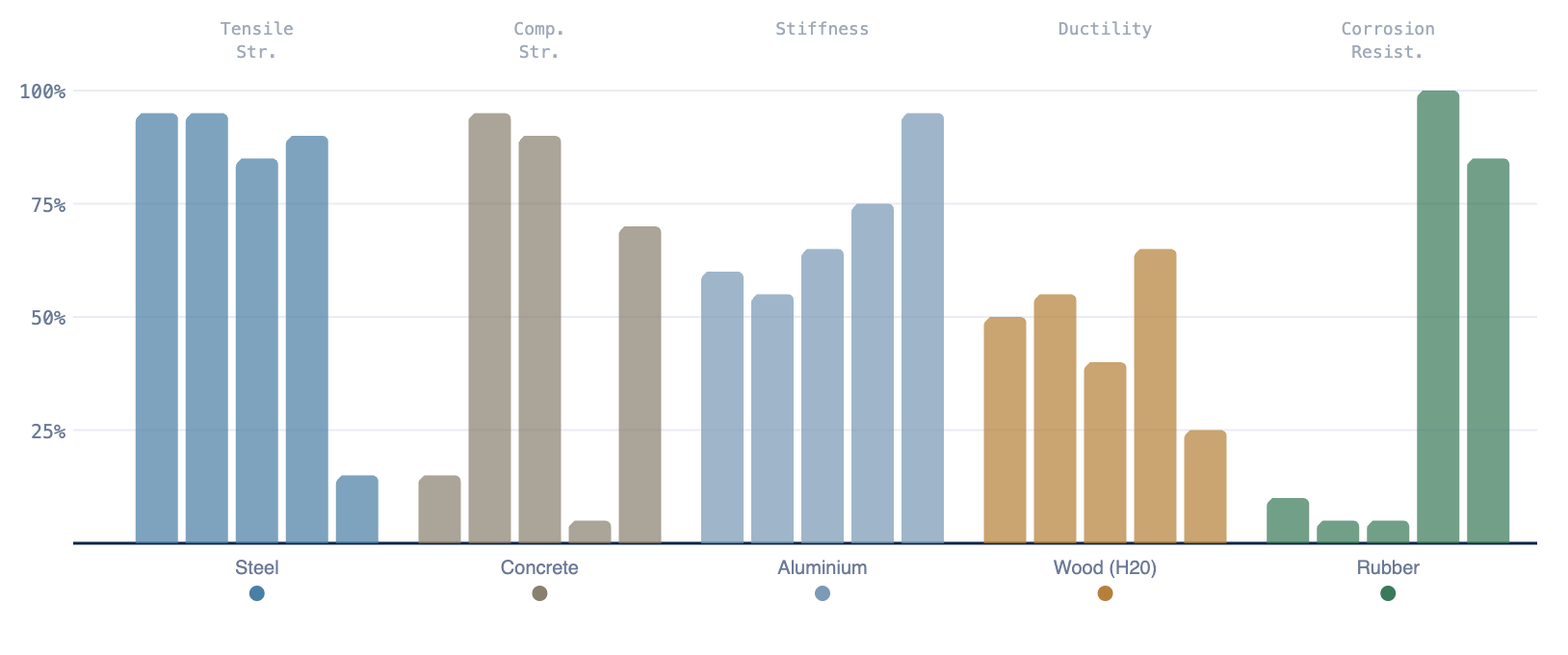
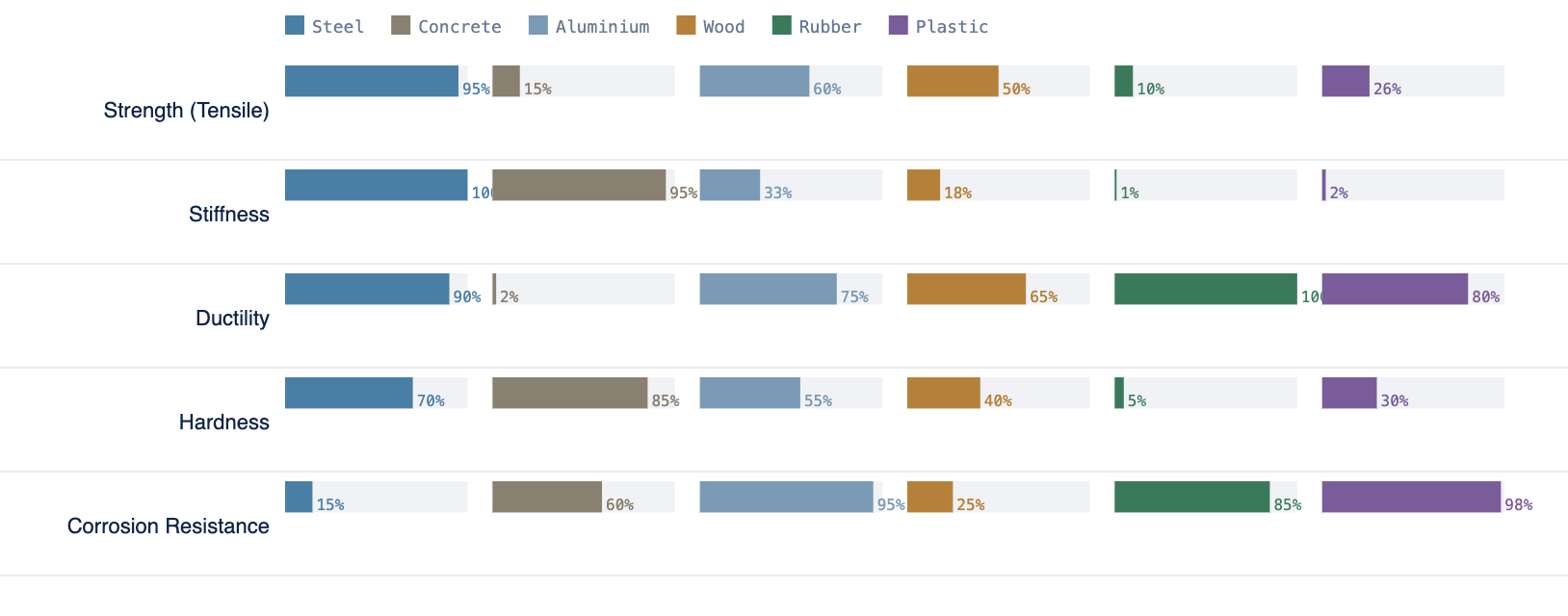
The ability of a material to resist a load without breaking. Measured in MPa (Megapascals). There are different types: tensile strength (pulling), compressive strength (crushing), and shear strength (cutting). Steel has high tensile and compressive strength. Concrete has high compressive strength but very low tensile strength.
How much a material resists deformation under load — not how strong it is, but how much it deflects. Steel is about 3× stiffer than aluminium. An aluminium beam of the same size as a steel beam will bend more under the same load, even if it hasn't reached its strength limit.
Resistance to surface scratching, indentation, and wear. Harder materials resist abrasion better. Hydraulic cylinder rods are hard chrome-plated to resist scratching from dust particles. Wear plates in batching plant hoppers use hard-steel to resist aggregate abrasion.
The ability to deform significantly before breaking. A ductile material bends, stretches, or yields visibly before failure — giving warning. Structural steel is ductile: an overloaded steel beam deflects visibly before collapsing. Ductility is a safety property.
The opposite of ductility — a brittle material breaks suddenly with no warning deformation. Glass, cast iron, and unreinforced concrete are brittle. Brittle failure is dangerous because there is no visible warning before fracture. This is why brittle materials are avoided in structural applications under tension.
The ability to absorb energy before fracturing — a combination of strength and ductility. A tough material resists sudden impact loads. Crane hooks are made from tough steel so that even an accidental overload does not shatter them. Toughness is especially important at low temperatures where some steels become brittle.
Stress and Strain — The Two Numbers Engineers Live By
You will hear engineers say "stress" and "strain." These are not the same thing, and confusing them with an engineer signals a gap.
Stress is the internal force per unit area inside a material when it is loaded. When you apply a force to a beam, the material inside resists by generating internal stress. Measured in MPa. Think of stress as the material's internal response to an external force.
Strain is the deformation that stress produces — specifically, the change in length divided by the original length. It has no unit. Strain is the material's physical change in response to stress. A 1m steel rod under tension that stretches 0.001m has a strain of 0.001 (or 0.1%).
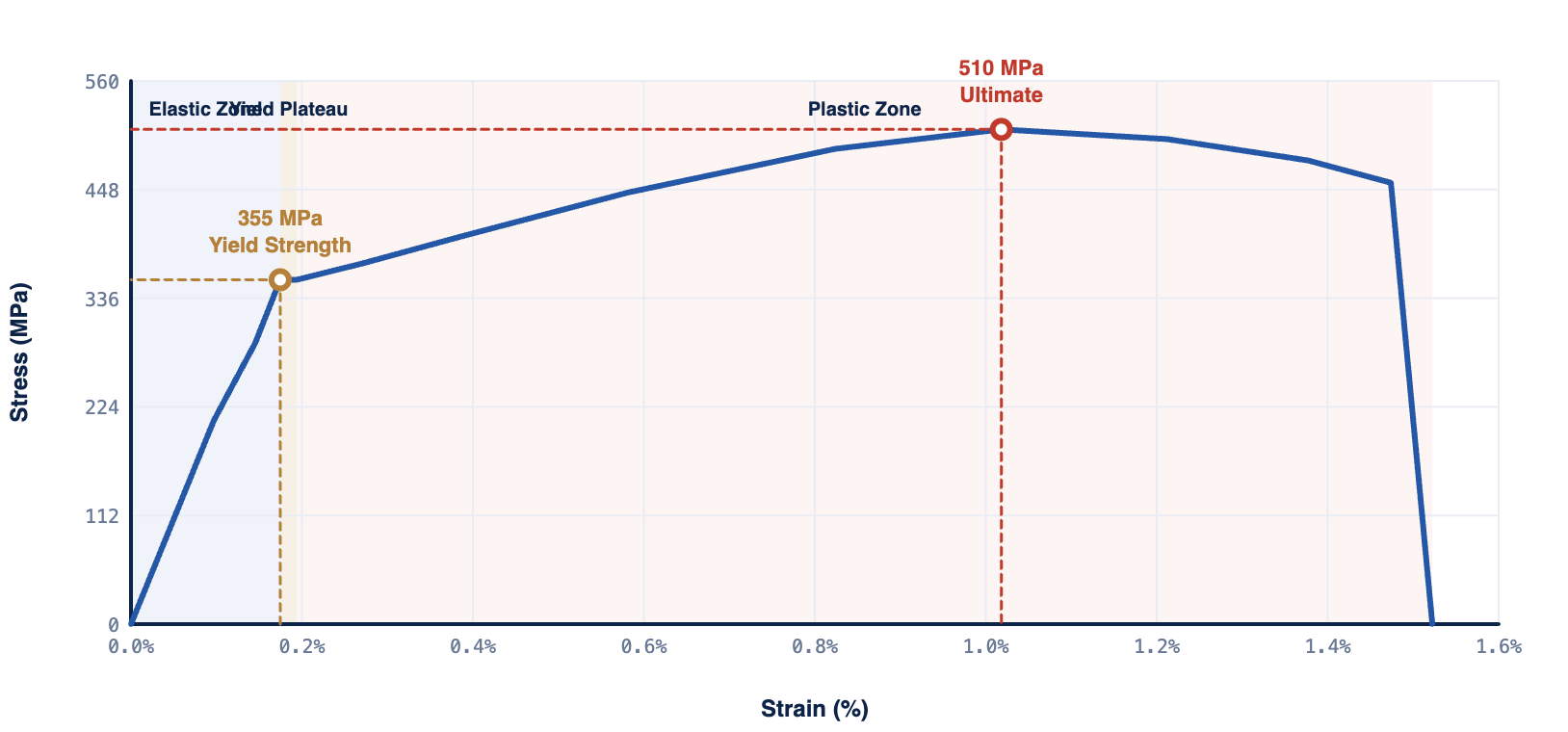
When an engineer specifies S355 steel for a crane boom instead of S235, the "355" is the yield stress in MPa. The S355 material can absorb more internal stress before permanently deforming. This allows a thinner, lighter boom section to carry the same load — which is why higher-grade steel makes equipment lighter without sacrificing capacity. That is a direct selling point for modern cranes.
Yield Strength vs. Ultimate Strength
Every structural material has two critical strength thresholds you must understand.
Yield Strength is the stress at which the material begins to permanently deform. Below yield strength, the material springs back to its original shape when the load is removed. Above it, the material is permanently stretched or bent — it will not return. Yield strength is the working limit engineers design around.
Ultimate Tensile Strength (UTS) is the maximum stress the material can carry before it fractures and breaks. Beyond yield but below UTS, the material is permanently deformed but still intact. At UTS, it breaks.
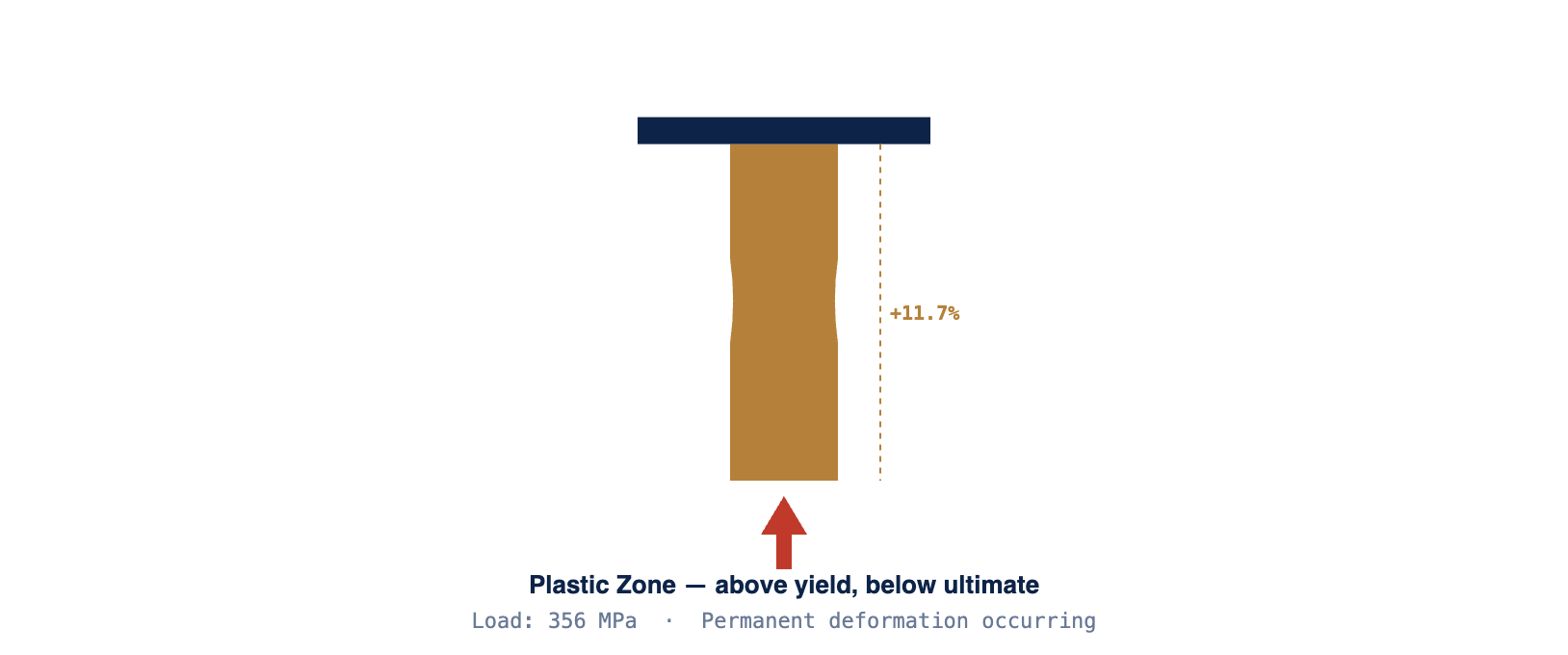
Material deforms elastically. Remove the load and it fully recovers. This is how all equipment is designed to operate. A crane hook stretches microscopically under load and returns to its original shape when the load is removed.
Material has permanently deformed. The structure still holds but is now misshapen. A bent scaffolding tube has yielded — it is no longer straight and its load capacity is reduced. It must be replaced, not straightened.
Crane wire ropes are rated with a Minimum Breaking Load (MBL) — the ultimate strength — and a Safe Working Load (SWL), which is the MBL divided by the safety factor (typically 5 or 6 for lifting gear). The wire rope should never be loaded beyond the SWL in normal use, which is far below the yield point of the steel wires. If a wire rope shows kinks, broken wires, or corrosion pitting, its actual strength has dropped below the rated MBL. The rope must be retired.
Elastic vs. Plastic Deformation
These two terms describe what happens to a material after it has been deformed.
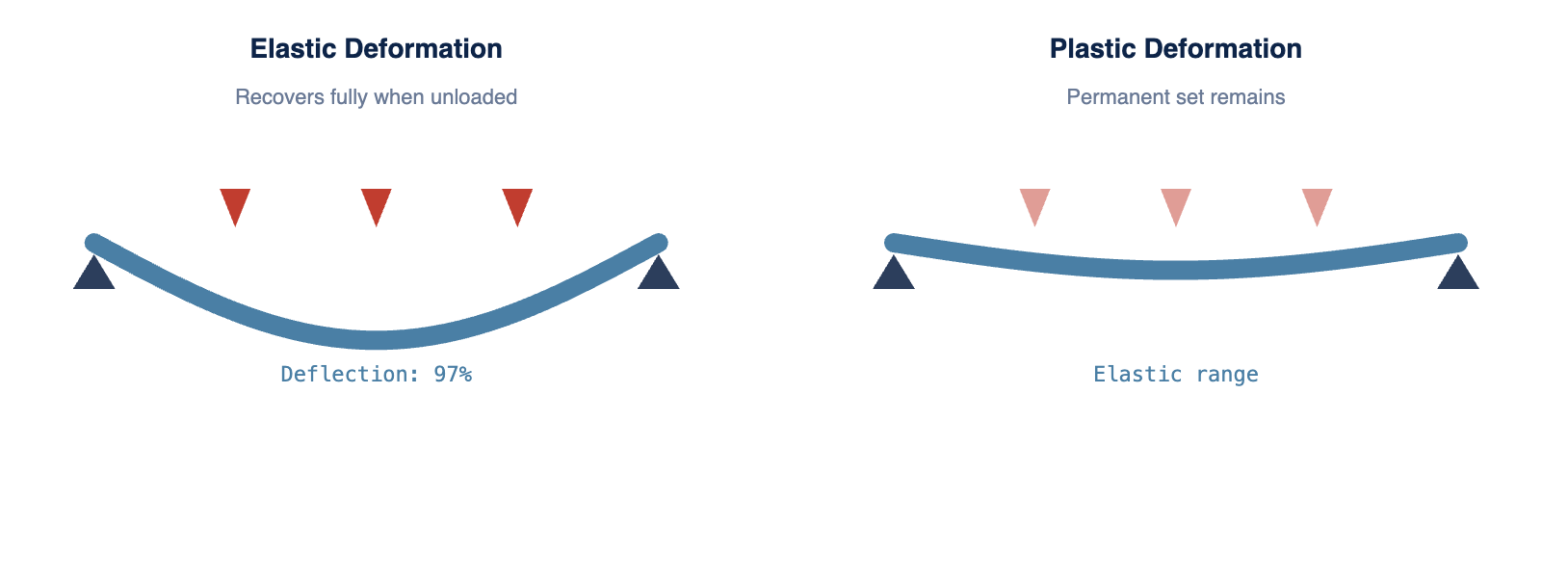
Elastic deformation is reversible. The material stretches or bends under load and returns completely to its original shape when the load is removed. This is how a spring works. All structural materials are designed to remain in the elastic range during normal use.
Plastic deformation is permanent. The material has been stretched or bent beyond its yield point and does not return to its original shape. A bent pipe, a kinked wire rope, a deformed bolt — these have all undergone plastic deformation. They are compromised and typically require replacement.
Load it and it deforms. Remove the load and it fully recovers. A steel beam loaded within its design range deflects measurably at midspan — engineers calculate this deflection — and returns to level when unloaded. This is normal and expected behaviour.
Construction example: An H20 formwork beam deflects under wet concrete load. Once the concrete sets and props are removed, the beam is reused — because it was only elastically deformed.
Load it beyond yield and it stays deformed. Remove the load and the deformation remains. This is a structural warning sign. Plastically deformed components carry less load, can no longer perform their design function, and often have internal damage that is not visible.
Construction example: A scaffolding tube that has been struck by heavy equipment and bent is plastically deformed. Its section properties are changed. Even if straightened, it is weakened and should be discarded.
Fatigue — How Materials Fail Under Repeated Loading
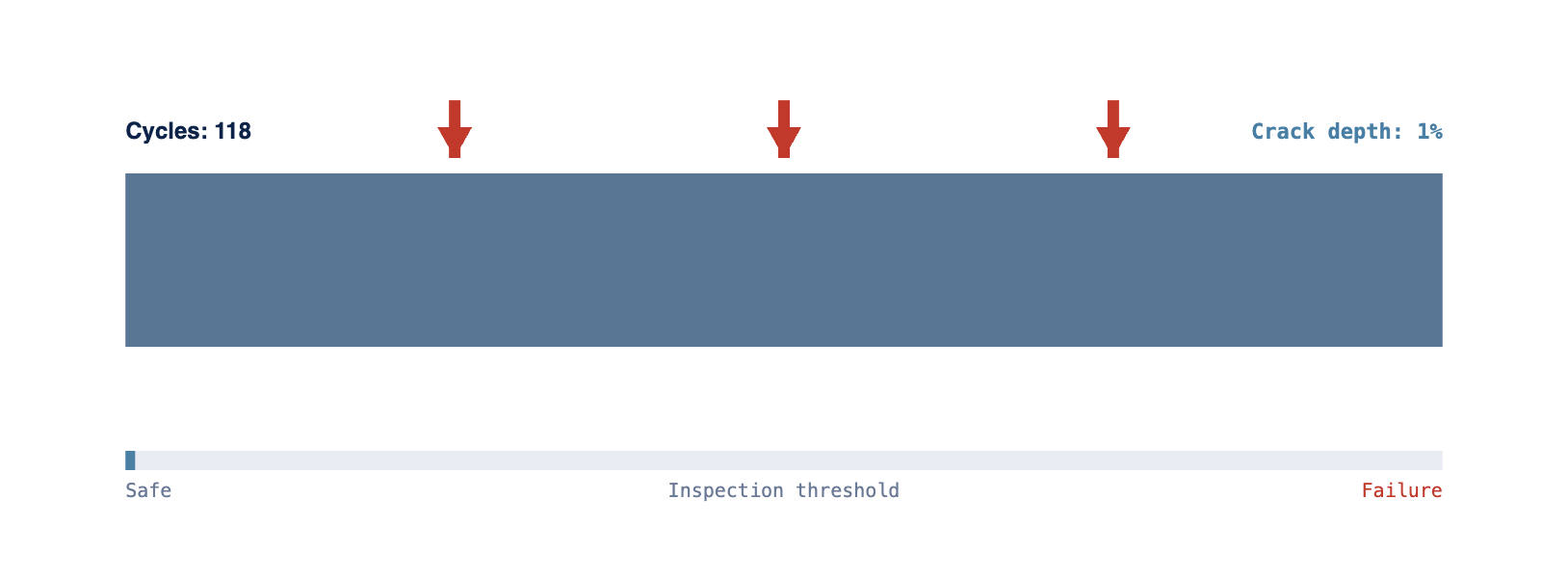
A component can fail at a stress level far below its yield strength if that stress is applied and removed repeatedly. This is called fatigue failure. It is one of the most common failure modes in construction machinery, and one of the most dangerous because there is often no visible warning before fracture.
Imagine bending a paperclip back and forth. Each individual bend does not come close to breaking it. But after enough cycles, a crack initiates at a stress concentration (a notch, a weld, a bolt hole) and propagates invisibly through the material. Eventually, the remaining intact cross-section is too small to carry the load, and the component fractures suddenly.
Tower cranes and mobile cranes are rated with a fatigue life — a number of load cycles over which the structural welds, boom sections, and connections are certified to remain safe. This is expressed as a crane classification (e.g. FEM group M5 or M7). A crane classified M5 is designed for a lower number of load cycles than an M7. When a rental crane is used far more intensively than its classification, fatigue cracks can develop in boom welds years before any external deformation is visible. This is why crane inspection and log books are not bureaucracy — they are fatigue life management.
A project manager asks:
"Why does this pump need a full inspection every 2,000 operating hours? It hasn't
broken."
The answer is fatigue. The pump's shaft rotates at hundreds of RPM, bending slightly under
load with every revolution. After 2,000 hours at, say, 500 RPM, the shaft has completed
around 60 million bending cycles. The inspection interval exists because fatigue cracks,
once past a critical size, grow rapidly to fracture with no further warning. Preventive
inspection is far cheaper than a failed pump, a flooded excavation, or an emergency repair
on a live pour.
Stress concentrations (sharp corners, notches, weld toes) dramatically reduce fatigue life. A smooth polished shaft may survive 10 million cycles; the same shaft with a small sharp groove may fail at 100,000 cycles. This is why hydraulic cylinder rods are mirror-finished, why structural welds on crane booms are ground smooth, and why nicks and gouges on shafts and rods are not cosmetic defects — they are fatigue initiation sites.
Corrosion and Wear — How Materials Deteriorate Over Time
A material that is perfect on day one may be compromised after a year on a construction site. Two mechanisms account for most material degradation in construction equipment: corrosion and wear.
Corrosion
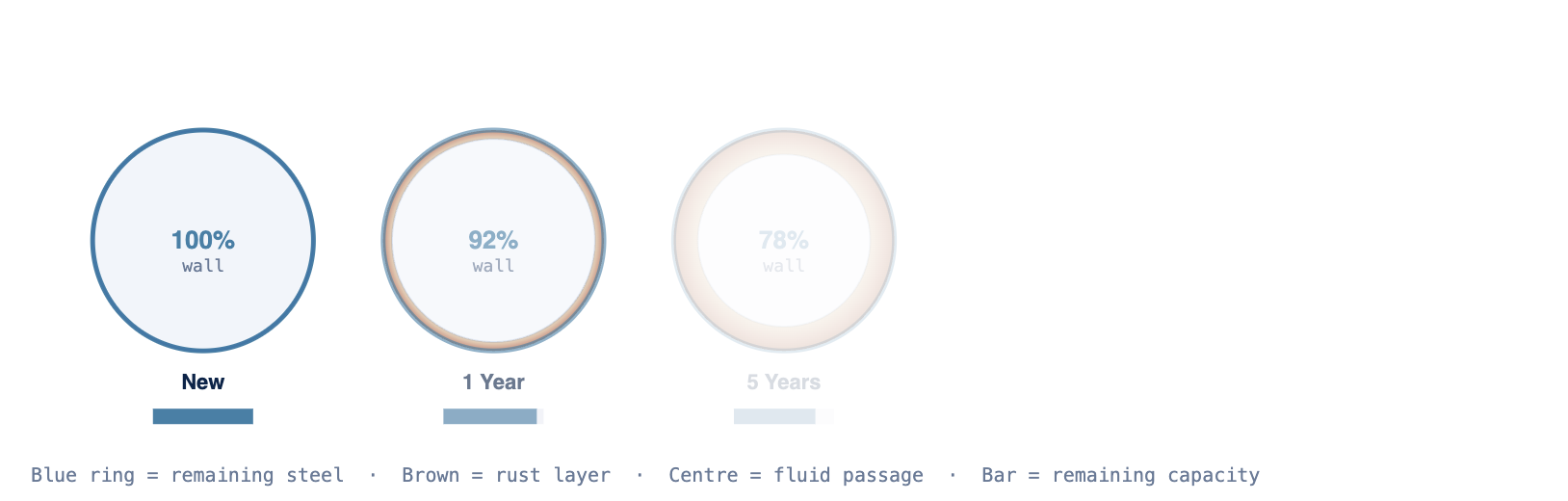
Corrosion is the chemical degradation of a material through reaction with its environment. In steel, rust is the most common form — iron reacts with oxygen and water to form iron oxide (rust), which is weaker and more brittle than the parent steel. Corrosion progressively reduces the effective cross-section of a structural member, lowering its load capacity below its rated value.
When two dissimilar metals contact in a wet environment, the less noble metal corrodes faster. Never connect aluminium fittings directly to steel pipes in wet conditions without isolation.
Occurs in tight gaps where moisture is trapped and oxygen is depleted. Under bolt heads, inside threaded joints, and beneath coatings are all high-risk zones. Common in pipe flanges and scaffold connections.
Small pits form on the surface that act as stress concentration points, dramatically accelerating fatigue crack initiation. Pitting on hydraulic rod surfaces is a critical defect — the rod must be replaced.
Wear
Wear is the physical removal of material through mechanical contact. In construction equipment, wear is everywhere: mixer blades abraded by aggregate, conveyor belt rollers worn by continuous contact, hydraulic seals worn by rod movement, pump impellers eroded by pumped slurry.
Understanding wear is the foundation of a spare parts business conversation. Every wear part has a predictable life: mixer blades wear at a measurable rate depending on aggregate type and batch volume. Hydraulic seals have service intervals based on rod cycles. A client who understands wear cycles will budget for preventive replacement rather than emergency repair. Your job is to make that case quantitatively — "at your production rate, the wear liners will need replacement every X months. Here is the cost comparison between planned replacement and an unplanned shutdown."
Safety Factors — Why Engineers Always Overdesign
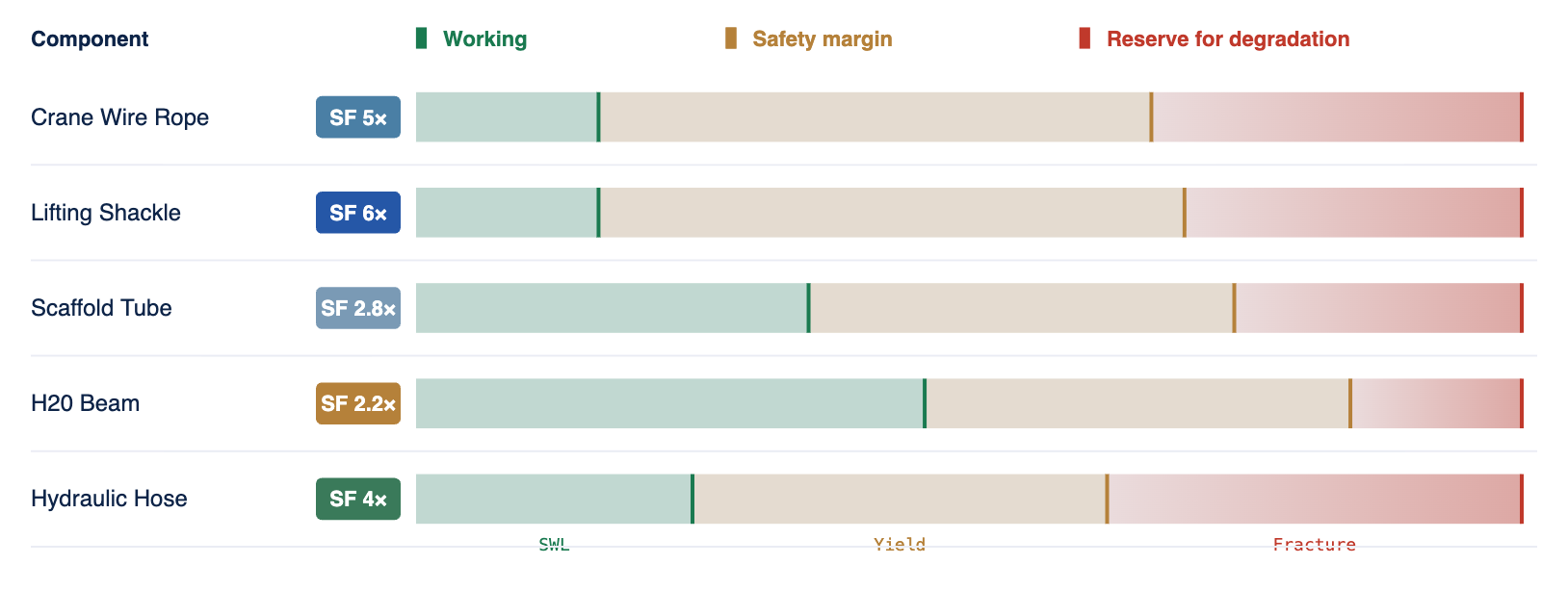
Every piece of equipment you sell has a rated capacity that is lower — often much lower — than the load at which it would actually fail. The ratio between actual failure load and rated working load is the safety factor.
Safety factors exist because of uncertainties that engineers cannot fully eliminate:
Even within the same steel grade, actual yield strength varies slightly batch to batch. The rated grade is a guaranteed minimum, not a uniform value. Safety factors absorb this uncertainty.
Actual loads in use often exceed static design loads due to impact, vibration, and dynamic effects. A crane suddenly braking a load generates forces higher than the load's static weight.
Welds, drilled holes, and machined surfaces introduce small imperfections that reduce local strength. Safety factors account for the gap between ideal and real geometry.
Corrosion, wear, and fatigue progressively reduce a component's actual strength below its original rated value. A freshly manufactured crane hook has its full safety factor. After years in service, some of that margin has been consumed.
Lifting slings and shackles: 4–6×. Crane wire ropes: 5–6×. Structural steel beams in buildings: 1.5–2×. Hydraulic hoses: 4× burst pressure vs working pressure. Scaffolding components: 2–3×. The higher the consequence of failure and the harder to inspect, the higher the safety factor. Wire ropes on lifting hooks get 5× because a fracture at height kills people and there is no warning. Building beams get 1.5× because failure is slow, visible, and not instant.
Clients sometimes ask whether equipment can "just handle" a slightly higher load than rated. The answer is always no, and the reason is this: the safety factor is not empty headroom that can be borrowed. It exists to absorb variability, dynamic effects, and degradation. A crane hook loaded to 110% of SWL is not 10% overloaded — it has consumed a portion of the safety margin that exists to handle all the uncertainties listed above. If the hook also has a hidden fatigue crack, has been impact loaded, or was manufactured at the lower end of its tolerance, 110% of rated load may be 110% of actual capacity.
Lesson 4 — Materials Comparison Table
| Material | Tensile Strength | Compressive Strength | Stiffness | Ductility | Corrosion Resistance | Key Failure Mode |
|---|---|---|---|---|---|---|
| Structural Steel (S355) | Very High (510 MPa UTS) | Very High | Very High (200 GPa) | Excellent — bends before breaks | Poor — rusts without protection | Fatigue at welds, corrosion |
| Concrete (C30) | Very Low (3 MPa) | High (30 MPa) | High (30 GPa) | None — brittle | Good in dry conditions | Cracking in tension, carbonation, rebar corrosion |
| Aluminium (6061) | Medium (310 MPa UTS) | Medium | Medium (70 GPa) | Good | Excellent — self-oxidising | Fatigue (lower endurance limit than steel), galvanic corrosion |
| Engineered Wood (LVL) | Medium (varies by grain direction) | Medium | Low–Medium (12 GPa) | Moderate | Poor — moisture degrades rapidly | Moisture delamination, web buckling, bearing crush |
| Nitrile Rubber | Low (10–20 MPa) | N/A | Very Low (0.01 GPa) | Extreme | Good (oil resistant) | Extrusion under excess pressure, heat degradation, chemical attack |
| HDPE Plastic | Low–Medium (26 MPa) | Medium | Very Low (0.8 GPa) | High | Excellent — chemical resistant | Creep under sustained load, UV degradation, impact splitting at cold temperatures |
Material Properties to Equipment Use Cases
| Equipment / Component | Material Used | Key Property Required | Failure to Avoid |
|---|---|---|---|
| Crane boom | High-strength steel S355–S690 | High yield strength, ductility, weldability | Fatigue cracking at welds, buckling |
| Concrete batching mixer drum | Wear-resistant steel (Hardox) | Hardness, wear resistance | Abrasion thinning of drum wall |
| H20 formwork beam | LVL flanges + plywood web | Bending strength, light weight | Moisture delamination, bearing failure |
| Hydraulic cylinder rod | Induction-hardened steel, chrome-plated | Hardness, surface finish, fatigue resistance | Pitting corrosion → seal failure, fatigue fracture |
| Hydraulic seals | Nitrile or polyurethane | Flexibility, oil resistance, pressure tolerance | Extrusion, hardening, chemical degradation |
| Concrete pump pipeline | Hardened steel (ST52) | Wear resistance, pressure rating | Abrasive thinning, pitting corrosion |
| Lifting wire rope | High-carbon steel wires | Tensile strength, fatigue life, flexibility | Wire fatigue fracture, corrosion pitting |
| Crane hook | Alloy steel, quench and tempered | Toughness, ductility (give warning before fracture) | Brittle fracture at low temperature, overload bending |
| Scaffolding tube | Grade 43 or 50 steel | Compression strength, ductility, weldability | Buckling, corrosion perforation |
| Concrete pipe (precast) | Reinforced concrete | Compressive strength + rebar for tension | Cracking under bending, sulphate attack |
- Material selection is never arbitrary. Steel in crane booms, rubber in hydraulic seals, engineered wood in H20 beams — each is there because of specific property requirements. Knowing why is a selling argument.
- Concrete is strong in compression and weak in tension. Rebar is not decoration — it handles the tension forces that concrete cannot. A batching plant that produces inconsistent concrete is producing a structural liability for the site engineer.
- Yield strength is the working limit. Ultimate strength is the failure point. Equipment must operate below yield. Anything that causes yielding — overload, impact, corrosion thinning — has consumed part of the safety factor.
- Elastic deformation is normal. Plastic deformation is damage. A bent scaffolding tube, a kinked wire rope, or a deformed anchor bolt has been permanently weakened and must be replaced regardless of whether it is still holding load.
- Fatigue failure gives no warning. Cracks initiate at stress concentrations — notches, weld toes, surface damage — and propagate invisibly. Service intervals and inspection protocols are fatigue life management, not over-caution.
- Safety factors are not empty headroom. They absorb material variability, dynamic loads, manufacturing imperfections, and years of degradation. Encouraging a client to exceed a rated load is not helpful — it is dangerous and creates liability.
- Wear and corrosion progressively reduce effective strength. A component in service is not as strong as a new one. Planned replacement based on wear cycles is far cheaper than emergency shutdown caused by unexpected failure.